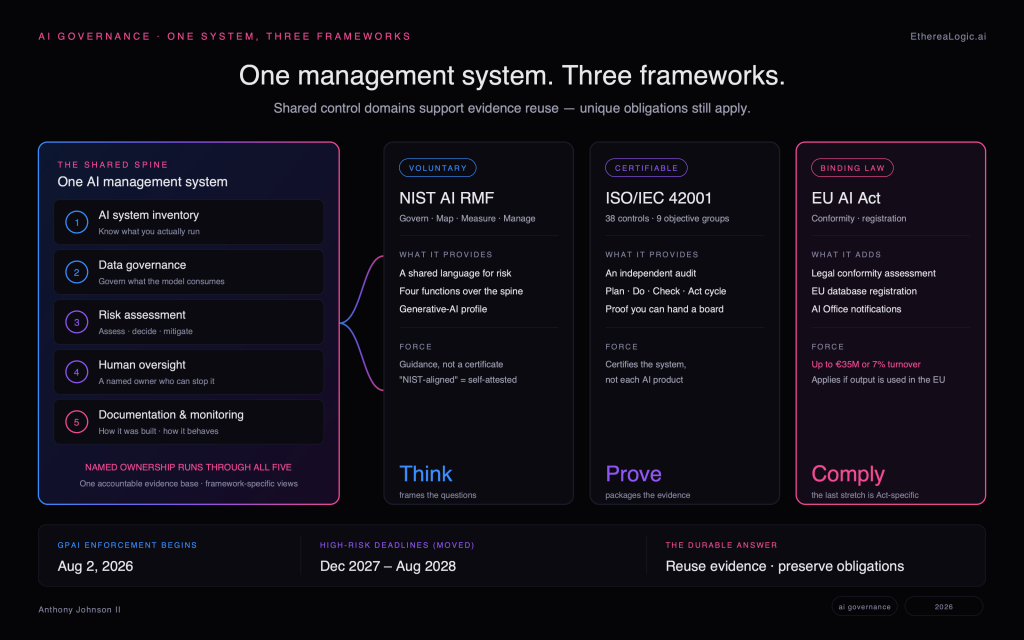
There are three names an AI governance conversation eventually arrives at — the NIST AI Risk Management Framework, ISO/IEC 42001, and the EU AI Act — and organizations can treat them as three separate obligations to be satisfied by three separate programs. They are not equivalent, but they share enough control domains that a single set of internal processes can produce much of the evidence all three demand. Two opposite failure patterns follow when that overlap is missed. A large enterprise can build overlapping compliance programs that repeatedly collect similar evidence. A mid-market organization with less governance capacity can defer a formal framework while adoption continues. Both responses are expensive. Only one of them is visibly expensive.
The regulatory calendar is what forces the issue, and it is worth stating precisely, because the precise version is less alarming and more useful than the headline version. The EU AI Act’s obligations for general-purpose AI models took effect on August 2, 2025, and the European Commission’s power to enforce them — including fines of up to €15 million or 3% of worldwide annual turnover under Article 101 — begins August 2, 2026. The Act’s obligations for high-risk systems, however, are no longer on the timeline most 2025 planning decks assumed: the Digital Omnibus on AI, which cleared its final Council approval on June 29, 2026, postponed them to December 2, 2027 for standalone Annex III use cases and August 2, 2028 for AI embedded in regulated products. The deadlines moved because the technical standards meant to support them were not ready in time. That is the tell this article is built around: the compliance calendar is a moving target, and an organization that builds a date-driven scramble around each deadline will rebuild it every time Brussels adjusts the date. An organization that builds one durable management system answers the question once and keeps answering it as the dates slide.
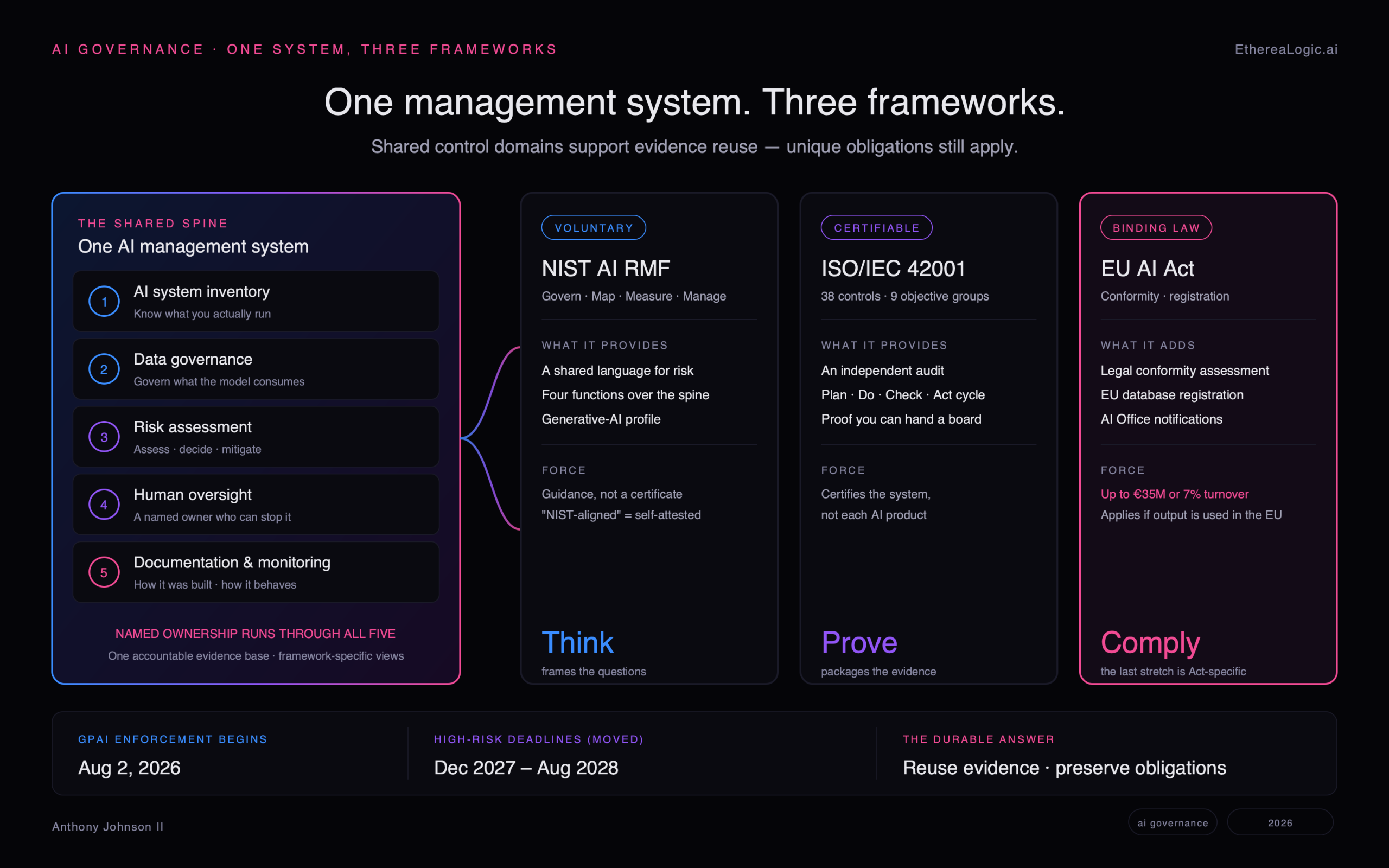
The three frameworks differ in force — voluntary guidance, certifiable standard, binding law — but they draw on a shared set of controls. One management system produces the evidence; each framework consumes a different view of it.
This is the second article in the EthereaLogic series on deploying AI at the mid-market and enterprise levels. The first article mapped the gap between a working demo and durable production, and argued that the barriers are organizational, not model quality. Governance is the fourth of those barriers, and the one most likely to be deferred until a regulator, an auditor, or a customer’s security questionnaire makes it urgent. This article is about doing it once, sized for organizations on both sides of the mid-market line.
Three Frameworks, One Set of Questions
The three frameworks differ most in their force — what happens to you if you ignore them — and that difference is the first thing to get straight, because it determines which ones are optional.
The NIST AI Risk Management Framework is voluntary. Released in January 2023, it is guidance rather than regulation; there is no certificate, and no one audits you against it. Its structure is four functions — Govern, Map, Measure, and Manage — with Govern as a cross-cutting culture-and-accountability layer that runs through the other three. In July 2024, NIST added a Generative AI Profile (NIST-AI-600-1) that maps a catalog of generative-AI-specific risks onto those same four functions. NIST’s value is not compliance leverage, because it confers none. Its value is that it gives the other two a common language: risk identification, measurement, and management, owned by someone.
ISO/IEC 42001:2023 is the first certifiable AI management system standard, published in December 2023. Unlike the NIST framework, an organization can be independently audited and certified against it by an accredited body, which is why it has become the artifact a security team can put in front of a customer or a board. It follows the same management-system pattern as ISO/IEC 27001 — a Plan-Do-Check-Act cycle wrapped around a normative set of controls. Its Annex A specifies 38 controls organized into nine objective groups, covering AI policy, internal roles and responsibilities, resources, impact assessment, the AI system life cycle, data for AI systems, information for users, use of AI systems, and third-party relationships. If you read that list next to the NIST four functions, you have already noticed the overlap. It is not a coincidence; the standard was written to be interoperable with the existing risk vocabulary.
The EU AI Act is the only one of the three that is law. It is a binding regulation (Regulation (EU) 2024/1689) with extraterritorial reach and real penalties, and it does not care whether you find it convenient. Its enforcement structure is tiered: prohibited practices carry fines up to €35 million or 7% of worldwide annual turnover; most other violations up to €15 million or 3%; supplying incorrect information to authorities up to €7.5 million or 1%. Its scope is what makes it everyone’s problem and not just Europe’s — a US company falls under the Act if it places an AI system on the EU market or if the output of its system is used in the Union, which is a lower bar than deliberately selling into Europe. And unlike the other two, the EU AI Act imposes specific legal machinery for high-risk systems that no voluntary framework can substitute for: formal conformity assessment, registration in an EU database, technical documentation to a prescribed standard, and, for the largest general-purpose models, direct notification to the AI Office.
Three different instruments, then: one that helps you think, one that lets you prove it, one that can fine you. But hold them side by side and five shared control domains emerge. Do you know which AI systems you are running? Is the data feeding them governed? Have you assessed the risks of each, with a named owner for the decision? Is there meaningful human oversight, including authority to intervene or stop the system where required? Can you produce documentation of how it was built and evidence of how it is monitored? Each framework addresses those domains, although its exact requirements, terminology, evidence, and legal effect differ. The useful overlap is a governance architecture, not proof that the instruments are interchangeable.
Two Wrong Answers
That convergence is exactly what the two operating patterns in this series get wrong, in opposite directions.
The enterprise pattern is duplication. A large organization with a mature compliance function can treat each framework as a program with its own owner, its own tooling, its own audit cycle, and its own evidence repository — the NIST alignment effort in the AI office, the ISO 42001 certification project under the security team, the EU AI Act readiness program run out of legal. Each may produce an AI system inventory, commission risk assessments, and write data-governance policy. The inventories can drift out of sync, the risk registers can use different taxonomies, and the organization can pay repeatedly to produce similar evidence — then pay again to reconcile inconsistent answers. This is an operating-pattern risk, not a measured prevalence claim: the cited surveys do not establish how many enterprises run three separate programs or what triplication costs. The cost can also hide inside approved budgets, so no single line item looks wrong.
The mid-market pattern is absence. An organization with limited governance capacity may have no dedicated AI risk function, spare compliance capacity, or consulting budget sized for a multi-year certification. Confronted with three frameworks that appear to assume those resources, it can defer formal governance while adoption continues. In BDO’s 2025 survey of 210 senior finance leaders at US companies with $250M–$10B in revenue, 92% had implemented AI or planned to within twelve months, but only 43% had a formal AI governance framework in place. Those measures are not exact opposites, but their 49-point difference signals a governance-capacity gap in the surveyed population. The first article in this series separately cited Netrio’s finding that 82% of surveyed mid-market organizations had AI in production somewhere while 26% reported it scaled and governed enterprise-wide; those results describe different thresholds and must not be subtracted into a single “missing” share. The security consequence is also bounded: in IBM’s 2025 study of breached organizations, breaches involving unmanaged “shadow AI” added roughly $670,000 to the average breach cost, and 63% of the studied organizations had no AI governance policy.
These are opposite failure patterns, not universal descriptions of either market segment: one creates duplicated program cost, while the other leaves governance gaps as adoption continues. The architectural response is the same for both, scaled to size: maintain one shared evidence base across the five control domains, then produce the framework-specific views and legal artifacts each instrument actually requires.
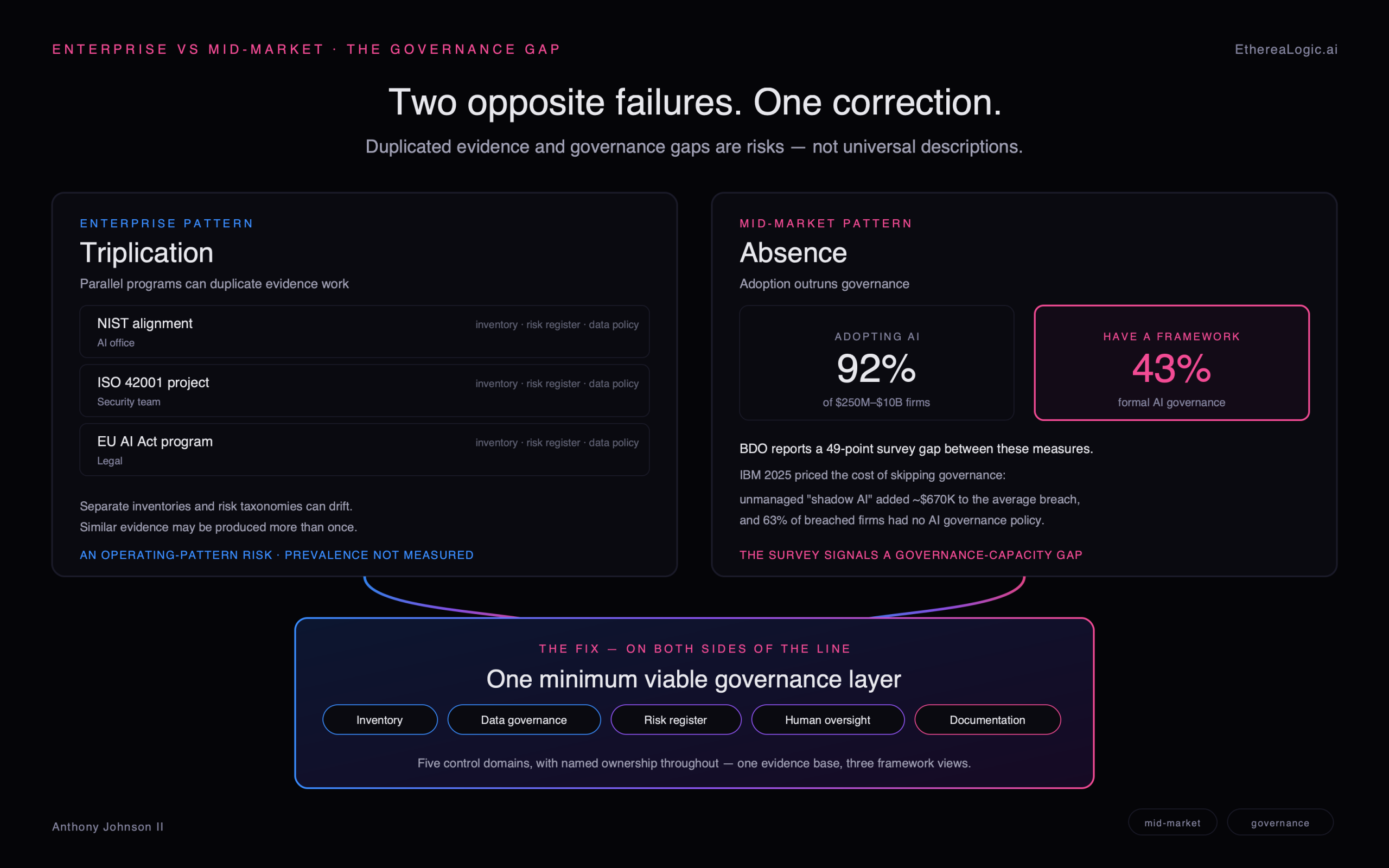
Opposite failures, one correction. The enterprise problem is triplication; the mid-market problem is absence. A single governance layer — one inventory, one risk register, one set of controls — is the fix on both sides of the line.
The Shared Spine
What does “one system” actually contain? Strip the three frameworks down to what they have in common and you get a small, unglamorous set of load-bearing controls. This is the spine, and everything the three frameworks ask for is a projection of it.
An AI system inventory. You cannot govern what you have not enumerated. NIST’s Map function begins here; ISO 42001 requires it through its life-cycle and impact-assessment controls; the EU AI Act’s entire risk-tiering exercise presumes you know which systems you run and what they do. One inventory, maintained as systems are added and retired, feeds all three. Most organizations discover on building it that they own more AI than they thought — which is the point.
Data governance. Every framework treats the data feeding an AI system as a first-class risk surface, not an implementation detail. This is the same argument the data trust articles on this blog made from the engineering side: the organization that validates only what the AI produces, and never what it consumes, inherits every unmeasured defect in the inputs. NIST’s Measure function, ISO 42001’s data controls, and the EU AI Act’s high-risk data-governance requirements are three demands for the same evidence.
Risk assessment and management. A documented process for identifying the risks of each system, judging their severity, deciding whether they are acceptable, and mitigating the ones that are not. NIST’s Map-Measure-Manage sequence is this. ISO 42001’s impact-assessment and risk controls are this. The EU AI Act’s conformity and risk-management requirements are this, made mandatory for high-risk systems. The output — a risk register with named owners and documented decisions — is one artifact that satisfies all three.
Human oversight and named ownership. Every framework insists that a human being is accountable for each system and has the authority to intervene or stop it. This is NIST’s Govern function, ISO 42001’s roles-and-responsibilities controls, and the EU AI Act’s Article 14 human-oversight requirement. In practice it is the single control most often missing, because ownership is the thing that falls through the cracks between the data science team that built the model and the business unit that wanted the outcome — the “boring middle” the first article named as an unowned failure mode.
Documentation and monitoring. A record of how each system was built and evidence of how it behaves in production. NIST’s Manage function, ISO 42001’s information and life-cycle controls, and the EU AI Act’s technical-documentation and post-market-monitoring obligations all draw on this. Build it once, as a living record rather than a pre-audit scramble, and each framework reads the view it needs.
Five control domains — inventory, data governance, risk management, human oversight, and documentation and monitoring — with named ownership running through them. That is the minimum viable governance layer. It is not a certification and it is not a compliance program. It is the small set of practices that, once they exist, lets an organization reuse evidence while still completing the framework-specific and legal work that cannot be shared.
Where the Shortcut Ends
Here is the part the vendors selling “one framework to rule them all” tend to skip, and the house rule on this blog is to state the caveat as loudly as the claim. One management system produces most of the evidence all three frameworks demand. It does not make the two voluntary frameworks and the one law interchangeable, and treating them as interchangeable is its own failure mode.
The NIST framework confers no compliance standing whatever. It is a thinking tool; “NIST-aligned” is a self-attestation, not a certificate, and no regulator or customer is obligated to accept it as evidence of anything. ISO 42001 certification is stronger — it is an independent audit — but it certifies your management system, not your individual AI systems. A company can hold a valid ISO 42001 certificate and still operate a specific high-risk system that is non-compliant with the EU AI Act, because organization-level management-system certification and product-level conformity assessment are different things. And the EU AI Act grants a legal “presumption of conformity” only to European harmonised standards cited in the Official Journal — not to ISO 42001 and not to the NIST framework. The harmonised standard being drafted for the Act’s quality-management requirements, prEN 18286, is still in development, with CEN-CENELEC targeting delivery near the end of 2026; it is designed to let organizations reuse their ISO 42001 controls, but until it is published and cited, ISO 42001 certification is strong supporting evidence rather than a compliance shortcut. The shared spine gets you most of the way. The last stretch — formal conformity assessment, EU registration, the specific legal artifacts — is EU AI Act-specific work that no amount of NIST alignment or ISO certification completes for you.
None of that undermines the thesis; it sharpens it. The right architecture is one management system as the foundation, with a thin framework-specific layer on top of it for the obligations that are genuinely unique — the EU database registration, the conformity assessment, the AI Office notifications. What you refuse to duplicate is the foundation: the inventory, the data governance, the risk register, the ownership, the documentation. Those you build once.
What the Evidence Establishes
- The three frameworks address overlapping control domains — AI inventory, data governance, risk assessment, human oversight, and documentation/monitoring. NIST hosts crosswalks to the AI RMF, but some are community-contributed and its EU AI Act mapping predates the enacted law; this supports evidence reuse as a design goal, not a claim of requirement-by-requirement equivalence (NIST, ISO/IEC).
- The AI governance gap in the mid-market is measurable and wide: 92% of $250M–$10B-revenue firms have adopted or plan to adopt AI, but only 43% have a formal AI governance framework (BDO, 2025); across a broader governance-professional population, only 38% report a comprehensive AI policy (ISACA, 2026).
- Ungoverned AI carries a quantified cost: shadow AI was a factor in a fifth of the breaches studied and added roughly $670,000 to the average breach, and 63% of breached organizations had no AI governance policy (IBM Cost of a Data Breach, 2025).
What It Doesn’t
The frameworks’ overlap is real but it is not total, and no published figure reliably quantifies “how much of framework B you get for free by doing framework A” — the percentages that circulate (40%, 60%) are vendor estimates without a stated methodology, and this article does not repeat them. The governance-gap statistics above come from different surveys with different populations and different thresholds — “formal framework,” “comprehensive policy,” and “fully implemented program” are not the same bar — and stacking them into a single trend line would manufacture a precision none of them claims. The sources also do not establish that most enterprises run three programs or that most mid-market firms run none. What survives every caveat is the architectural point: the frameworks share important control domains, so organizations should reuse a governed evidence base while preserving the obligations unique to each instrument.
The Minimum Viable Governance Layer
For the mid-market reader, the practical claim of this article is that the governance layer described above is within reach without a dedicated AI compliance department. It is five control domains, not three parallel programs: an inventory of the AI systems you run, a data-governance rule for what those systems may consume, a lightweight risk assessment with a named owner and a documented accept/mitigate decision per system, meaningful human oversight, and a living record of how each system was built and how it behaves. A small organization can hold that evidence in a handful of documents and a review cadence, although its legal obligations still depend on its role, systems, and markets. The discipline the first article named for pilots applies here: a small organization may be able to keep one inventory current where a larger one struggles to keep several in sync.
For the enterprise reader, the assignment is the inverse and it is mostly subtractive. The compliance function will insist on most of the controls; the risk is not that they go unbuilt but that they get built three times. The work is to name one system of record for the AI inventory, one risk taxonomy, one data-governance policy, and one evidence repository — and to make the NIST, ISO, and EU AI Act efforts three consumers of that single source rather than three producers of parallel ones. That is a governance-architecture decision, not a tooling purchase, and it is cheaper to make now than to retrofit after three programs have each accumulated a year of divergent evidence.
The next and final article in this series turns to the case that makes all of this urgent: the agentic transition, where the systems being governed no longer just produce outputs but take actions — with credentials — and where the gap between one experimental agent and a governed production fleet is the difference between a wrong document and a reportable incident.
Get the templates
For a concrete implementation example, the agentic governance stack templates provide copy-paste-ready files for governing coding agents: CONSTITUTION.md, DIRECTIVES.md, SECURITY.md, AGENTS.md, CLAUDE.md, a protected-branch hook, and a SHA-pinned CI workflow. The kit illustrates inventory, approved tools and data-handling rules, explicit decision authority, runtime enforcement, and audit trails in one narrow domain. It is not a NIST AI RMF crosswalk, an ISO/IEC 42001 implementation package, or an EU AI Act compliance template; organizations must map and extend it for their own systems, roles, and legal obligations.
References
- NIST — AI Risk Management Framework (AI RMF 1.0) — voluntary framework released January 2023; four core functions (Govern, Map, Measure, Manage); no certification. Generative AI Profile, NIST-AI-600-1 (July 2024) maps generative-AI risks onto those functions. Crosswalks to the AI RMF — note that some crosswalks are community-contributed and NIST’s EU AI Act mapping tracks the earlier proposed text.
- ISO/IEC — ISO/IEC 42001:2023, Information technology — Artificial intelligence — Management system — first certifiable AI management system standard, published December 2023; Annex A specifies 38 controls across nine objective groups; certification-body requirements are set out in ISO/IEC 42006:2025.
- European Union — Regulation (EU) 2024/1689 (the EU AI Act) — binding law; general-purpose AI obligations effective August 2, 2025, with Commission enforcement and Article 101 fining power from August 2, 2026; penalty tiers up to €35M/7%, €15M/3%, and €7.5M/1% (Article 99); extraterritorial scope where system output is used in the Union (Article 2).
- Council of the EU — Artificial intelligence: Council gives final green light to simplify and streamline rules (June 29, 2026) — the “Digital Omnibus on AI” postpones high-risk obligations to December 2, 2027 (Annex III) and August 2, 2028 (Annex I); analysis via Morgan Lewis.
- CEN-CENELEC — AI standardization update (October 2025) — harmonised standards (including the prEN 18286 AI quality-management standard that will carry presumption of conformity) targeted for delivery near the end of 2026.
- BDO — 2025 Audit Innovation Survey — survey of 210 senior finance leaders at US companies with $250M–$10B in revenue; 92% have adopted or plan to adopt AI, but only 43% have a formal AI governance framework.
- ISACA — 2026 AI Pulse Poll — survey of more than 3,400 digital-trust professionals; 38% report a formal, comprehensive AI policy (up from 28% in 2025).
- IBM — Cost of a Data Breach Report 2025 — Ponemon Institute study of 600 breached organizations; shadow AI a factor in 20% of breaches, adding roughly $670,000 to the average cost, with 63% of breached organizations lacking an AI governance policy.
- Verizon — 2026 Data Breach Investigations Report — regular AI users among the workforce rose from 15% to 45% year over year, and 67% of employees access AI through non-corporate accounts on corporate devices.
- Prior EthereaLogic series — The Pilot Graveyard: Why Enterprise AI Stalls Before Production, CLAUDE.md Is Not Enough: The Governance Stack for Agentic Development, and You Validated the AI’s Code. Who Validated the AI’s Data?.
This is the second article in the EthereaLogic series on deploying AI at the mid-market and enterprise levels. The first article mapped the pilot-to-production gap. The third and final article covers the agentic transition — moving from one experimental agent to a governed production fleet.